Back to Discography

ゲスト
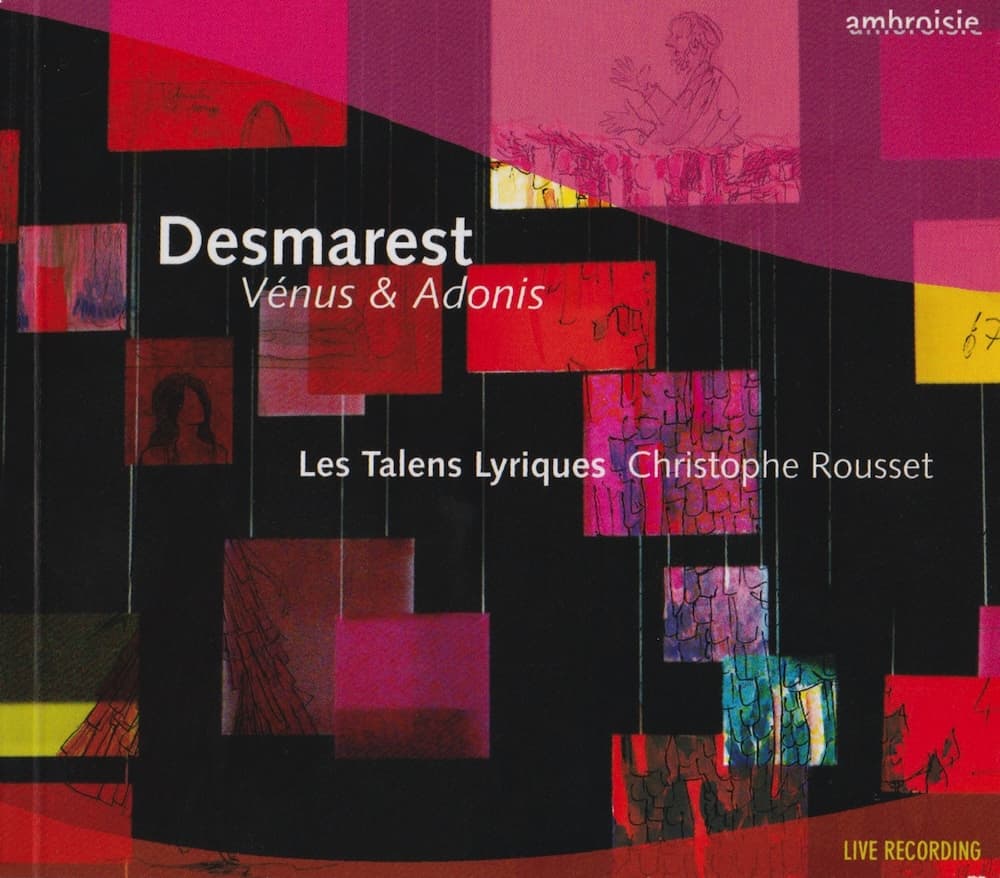
Desmasret, Vénus et Adonis
Year
2006
Production
AMBOISE - Nicolas BARTHOLOMÉE
Direction
Christophe ROUSSET (Les Talens Lyriques)
Mastering
Nicolas de BECO
Photos
Bernard QUESNIAUX
Graphic Design
NAÏVE
Listen on your favorite streaming platform
Details
Vénus & Adonis
by Jean Duron
Ainsi Vénus cessa. Les rochers, à ses cris, Quittant leur dureté, répandirent des larmes Zéphire en soupira: le jour voila ses charmes:
D'un pas précipité sous les eaux il s'enfuit, Et laissa dans ces lieux une profonde nuit.
La Fontaine, Adonis, 1658'
Just a few years after John Blow's splendid Venus and Adonis (c. 1683), on 28 July 1697, the stage of the Académie Royale de Musique in Paris saw the premiere of Henry Desmarests setting ofa libretto on the same theme by Jean-Baptiste Rousseau. The work was immediately published in short score by Christophe Ballard. This tragédie lyrique, which hymns the miracle of initiation to love, with its mixture of hesitation, desire, and apprehension, and leads its young hero to his death, appeared amid the turbulence of an incredible adventure that was to end in virtually defin. itive exile from the kingdom for the thirty-six-year old composer. His crime had been to seduce and, in the end, abduct the daughter of the powerful president of the election of Seniis. The sen. tence: death by hanging. However, since the composer had had the excellent idea of eloping with his youthful mistress before he was arrested, only his effigy was left to swing from the gallows.
As was said at the trial, Marie-Marguerite, at the tender age of eighteen, had received the dangerous gift of a voice capable of seducing others, and perhaps herself'. Desmarest had fallen head over in heels in love with both the voice and the person of his young pupil. This true-life tale of forbidden and thwarted love is constantly hinted at throughout Vénus & Adonis: how could it be otherwise? How can one imagine that the most beautiful airs in the work (such as Venus' 'Qu'un triste éloignement', V,6) were not conceived for and sung by Marie-Marguerite.
How can one not hear the delightful duets of Venus and Adonis ('Tendres prix des ames constantes', II, ), their delicate dialogues ('Par cet éloignement', IV, 1), being rehearsed at the Hôtel de Touraine in rue de Hautefeuille in Paris, where the two lovers had found refuge, whee Desmarest had a spinet delivered, where they conceived their first child?
The fruit of an incestuous love, Adonis was the fairest of mortals: protected by Diana, raised by wood nymphs, nourished on the sap of the myrrh tree, he had been condemned to know nothing of love throughout his life. At a time when she was weary of Mars, her irascible and excessively warlike husband, Venus, the very incarnation of love, beautiful, curvaceous, ardent, looked fondly on this ingenuous youth. She developed for him a complex sentiment mingling blissful admiration for one who was her precise opposite, a taste for forbidden fruit and also, quite certainly, a penchant for educating inexperience.
This attractive subject was seldom treated by the composers of Louis XIV's reign: did anyone still recall the tragédie en musique La mort d'Adonis composed long before by Pierre Perrin and
Jean-Baptiste Boesset?
On the contrary, in the other arts, as Cécile Bohnert has elegantly shown, the myth of Adonis enjoyed a genuine vogue at the time? The fashion went back to the publication in 1623 of the French translation of the celebrated poem Adone by Giambattista Marino, who had been received in Paris by Marie de Médicis; the work was dedicated to King Louis XIII, and Pope Urban VIII had placed it on the Index in 1627. This was the period when Nicolas Poussin painted his Death of Adonis, which figured in the collections of Louis XIV. The great Simon Vouet, probably in 1642, produced an Adonis brimming with emotion and sincerity: under the grave, tousled, heavy-lipped adolescent, Dorigny (who made the engraving) perceptively added the words 'Tu t'émerveilles, Adonis, de te voir dans les bras de Vénus'". Later, in 1685, the king acquired the fine canvases by Albani still held in the Louvre. He also commissioned Louis II Boulogne and François Verdier to paint pictures on the same theme for the Trianon; Verdier's were finished by the time Desmarest's opera appeared. So this subject was one that inspired both artists and patrons.
In the literary sphere there was the famous and extremely fine Adonis which Jean de La Fontan dedicated to Nicolas Fouquet in 1658. This poem too exalts the discovery of love, that object He loves, he feels an inferno coursing through his veins') sink into voluptuous pleasure: that surprises, astonishes and confuses', which makes powerless man ('What can Adonis do
Jours devenus moments, moments filés de soie, Agréables soupirs, pleurs enfants de la joie, Vœux, serments et regards, transports, ravissements.
Some years later, in 1670, Donneau de Visé presented his tragédie à machines (machine play) Les amours de Vénus & Adonis. This enjoyed great success at the Théâtre du Marais and was revived at the Comédie-Française, with divertissements by Marc-Antoine Charpentier, on 23 September 1685, shortly before the performances at court of Desmarest's first tragédie lyrique, Endymion (now lost). Finally, the story of Adonis provided the subject tor a musical divertisse. ment sung in the presence of Louis XIV in 1696, Just a few months betore the Desmarest opera
recorded here: only fragments of this have survived.
The subject of the love of Venus and Adonis was well suited to Desmarest, for it brought out his most notable qualities. He excelled in the expression of tender feeling, learned counterpoint, and broad lyrical gesture. He had learnt his lesson from the works he had sung as a young choirboy in royal service (page de la Chapelle du Roi), including pieces by Lully, Lambert, Du Mont and the Abbé Robert; later on, he knew and admired Charpentier. He was a sensitive artist' who was particularly successful with pathos, the portrait and in depiction of the affects. This gives great depth to his operatic characters, especially in Vénus & Adonis which in my view is the most accomplished of his tragédies lyriques: he handles its four main roles with meticulous care, detailing with rare delicacy the multiple facets of the soul, the changes, the hesitations, the contradictions. the strengths and weaknesses, the beauties and baseness of each of the protagonists.
Desmarest's theatre gains in force from his great skill in depicting the feelings of human beings. constantly in movement, fleeting, contradictory, over an astonishingly wide range of passions.
The composer is also fond of building such monumental edifices as the sublime Passacaille of Act
V, in which he can display his contrapuntal skill and the robustness and vitality of his musical structures. A singer himself, he was able to make ingenious use of the voice, and knew what he could ask of his performers. As a church musician experienced in the composition of grands motets, he was perfectly acquainted with the expressive and vocal possibilities of choral forces and their capacity to convey majesty, joy, violence, tumult, gentleness, fear, desolation - as can be seen, notably, in the chorus 'Prenez pitié de notre peine' (V,1). And, having frequented since childhood the string band of the Vingt-quatre Violons du Roi and the soloists of the Chambre du Roi, he had a matchless knowledge of the subtleties of the Lullian orchestra, its infinite expressive possibilities and its unique dynamics: throughout Vénus & Adonis, he makes it one of the strongest and most colourful characters in the opera.
Vénus & Adonis was the last tragédie lyrique by Desmarest to be performed in Paris before his headlong flight: it followed Didon (1693), which gave the Académie Royale de Musique one of its rare successes since the death of Lully in 1687; Circé (1694), inspired by Charpentier's Médée, performed some months earlier; and Théagène & Cariclée (1695), one of the finest scores of the period, based on a fabulous subject. Each of these works was attentively commented on by the critics of the time as a unique experience in its own right: in this respect the reader may refer to the fascinating correspondence (published by Jérôme de la Gorce) between Louis Ladvocat, a counsellor at the Grand Conseil, who regularly attended both performances and rehearsals of operas, and his correspondent in Beauvais, the Abbé Jean-Baptiste Dubos, later to become an eminent critic. The two men began writing to one another in September 1694, when Circé was in revival and Desmarest was preparing the score of Théagène & Cariclée. Their correspondence ended in 1698, and so it exactly covers the period of the composer's output. Clearly very close to Desmarest, whom he never criticises, Ladvocat also remarks on the content of the librettos, the quality of the verse, the characters of the protagonists, the interpretation of the singers and how the works were received by the audience; an excellent connoisseur of ancient drama, he generally sets out to be, for both the theatre and the opera, the guardian of a certain orthodoxy. Dubos, for his part, wrote a Critique de l'opéra Didon which deals with more or less the same points.
Alongside his operas, Desmarest composed two ballets, Les amours de Momus (1695) and Les festes galantes (1698). After he fled Paris, two more tragédies lyriques by him were premiered there: Iphigénie en Tauride (1704), which he had left unfinished and Campra completed (the resulting work was one of the biggest successes of the eighteenth century), and Renaud, which was given in 1722 on the occasion of the arrival in France of Louis XV's Spanish fiancée.
Vénus & Adonis was produced again in Paris some time before 1705, according to Lecerf de La Viéville, and then in 1717. We know of revivals of the work in Lunéville in 1707, Lyon in 1739, and Brussels in 1714, and at the court of Baden-Durlach in Germany (in 1713, then between 1714 and 1716). At Hamburg in 1725, when Telemann was director of the citys opera house, a comic prologue in German replaced Desmarest's original. Finally, excerpts from the opera were given at the Swedish court, and also in London between 1714 and 1725 the Passacaille). The libretto by Jean-Baptiste Rousseau (to whom we also owe a cantata entitle:
Adonis, set to music by Nicolas Bernier among others) was reused in its entirety by the composer Stanislas Champein in the early 1790s.
The work was still fresh in the memory in 1705, when the Rouen writer Lecerf de La Viéville used this tragédie lyrique to refute Raguenet's assertion that 'nothing fine has been achieved in France since the death of Lully'. Lecerf wrote: 'The music of Vénus & Adonis, whose words you have admired, was thought to be good by most connoisseurs, although embellishments roulemens, occur a little too frequently... This [he is discussing Desmarest's Vénus, but also Campras Hésione] will suffice to show M l'Abbé that, since the death of Lully, fine things have inder. been achieved in France Further on, railing against the cabals that ruin the best operas, he aga makes use of Vénus & Adonis to express his disapproval of this type of practice.
Some months after the first performance of Desmarest's work, a new period began for the mus cal theatre, involving young composers trained far from court and therefore free of the influenc of Lully, André Campra triumphed with his L'Europe galante, premiered on 24 October 1697,0% which Lecerf de La Viéville was to acknowledge some years later that 'no opera, even by Luly was more keenly followed than L'Europe galante'. At court, another first venture in the operas. genre by a composer of genius received unparalleled applause: it was in this same month o October that the fine Issé of André Cardinal Destouches was given before the king Fontainebleau. The piece was revived at the Académie Royale de Musique in late DecemberLouis XIV admitted that no 'music had given him such pleasure' since the death of Lully. With Issé, France entered a new musical era in which the very foundations of operatic discourse where shaken, a period of transition which led imperceptibly to Rameau.
1 .Thus Venus ceased. The rocks, at her cries, / Abandoning their hardness, shed tears; / Zephyrus sighed at them; dayveled its charms; / With speedy steps he fled under the waters / And left deep darkness in this place.
2. Cécile Bohnert, 'Les métamorphoses des amours de Vénus et Adonis ou la naissance d'un mythe à l'opéra', in Jean Duron and Yves Ferraton (eds.), Vénus & Adonis, tragédie en musique de Henry Desmarest (Liège: Mardaga, 2006).
3. It is now in the Musée de Caen.
4. Paul Getty Museum, Malibu.
5. 'You are filled with wonder, Adonis, to find yourself in the arms of Venus.'
6 Days become moments, moments spun in silk, / Pleasant sighs, tears born of joy, / Vows, pledges and glances, transports, raptures.'
7 The rest of this paragraph is taken from my article published in the volume mentioned in note 2.
Henry Desmarest 1661-1741
Vénus & Adonis Tragédie lyrique en cinq actes et un prologue (1697) Livret de Jean-Baptiste Rousseau s'inspirant des Métamorphoses d'Ovide
Création le 17 mars 1697 à l'Académie royale de musique de Paris
Édition scientifique réalisée par Jean Duron, éditée par le Centre de musique baroque de Versailles Recréation mondiale à l'Opéra national de Lorraine du 28 avril au 6 mai 2006, dans une mise en scène de Ludovic Lagarde
—Karine Deshayes MEZZO-SOPRANO VÉNUS
—Sébastien Droy TÉNOR ADONIS
—Anna-Maria Panzarella SOPRANO CIDIPPE
—Henk Neven BARYTON MARS
—Ingrid Perruche SOPRANO BELLONE
—Jean Teitgen BASSE LA JALOUSIE
—Anders J. Dahlin HAUTE-CONTRE SUIVANT DE MARS
Autres rôles dans les divertissements:
Laure Baert SOPRANO UNE HABITANTE DE CHYPRE, UNE DES FILLES (I), UNE HABITANTE (V)
Yu Ree Jang SOPRANO UNE HABITANTE DE CHYPRE (1 & V), UNE NYMPHE (III) Anders J. Dahlin HAUTE-CONTRE UN HABITANT (1), UN PLAISIR (III)
Jean Teitgen BASSE UN HABITANT (V)
Les Talens Lyriques
Chœur de l'Opéra national de Lorraine (Merion Powell CHEF DE CHOEUR)