Back to Discography
Guest
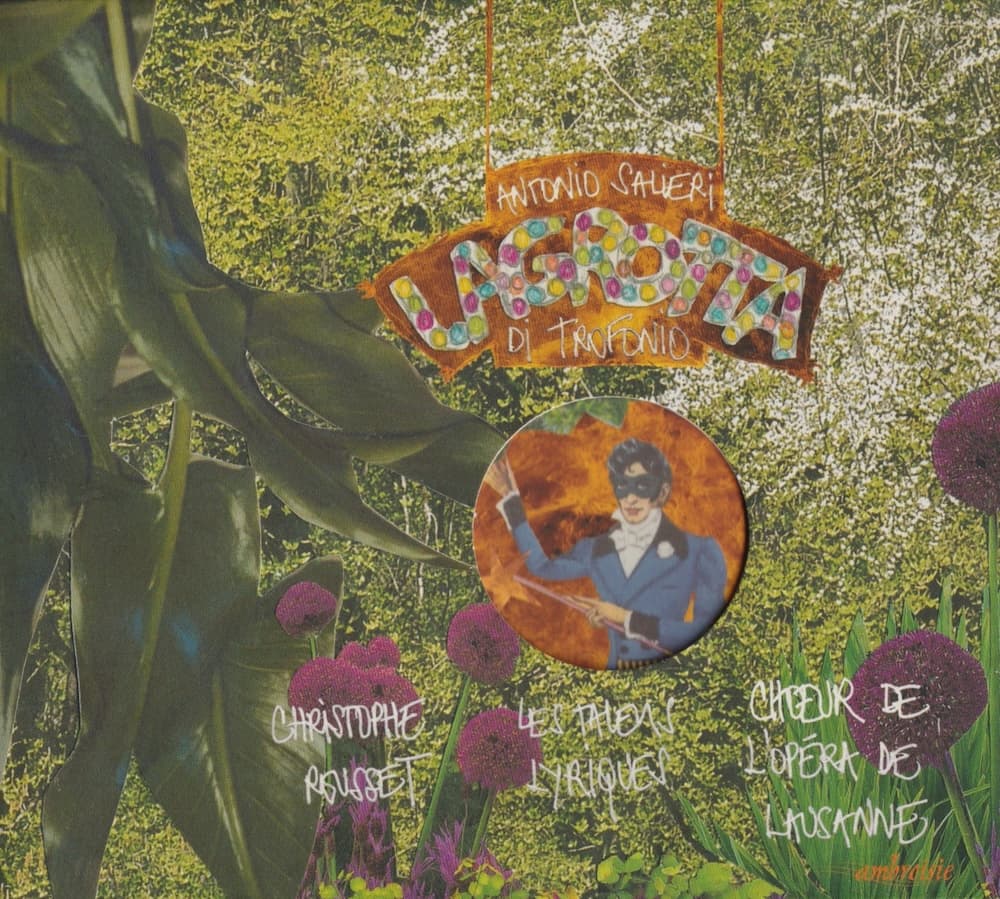
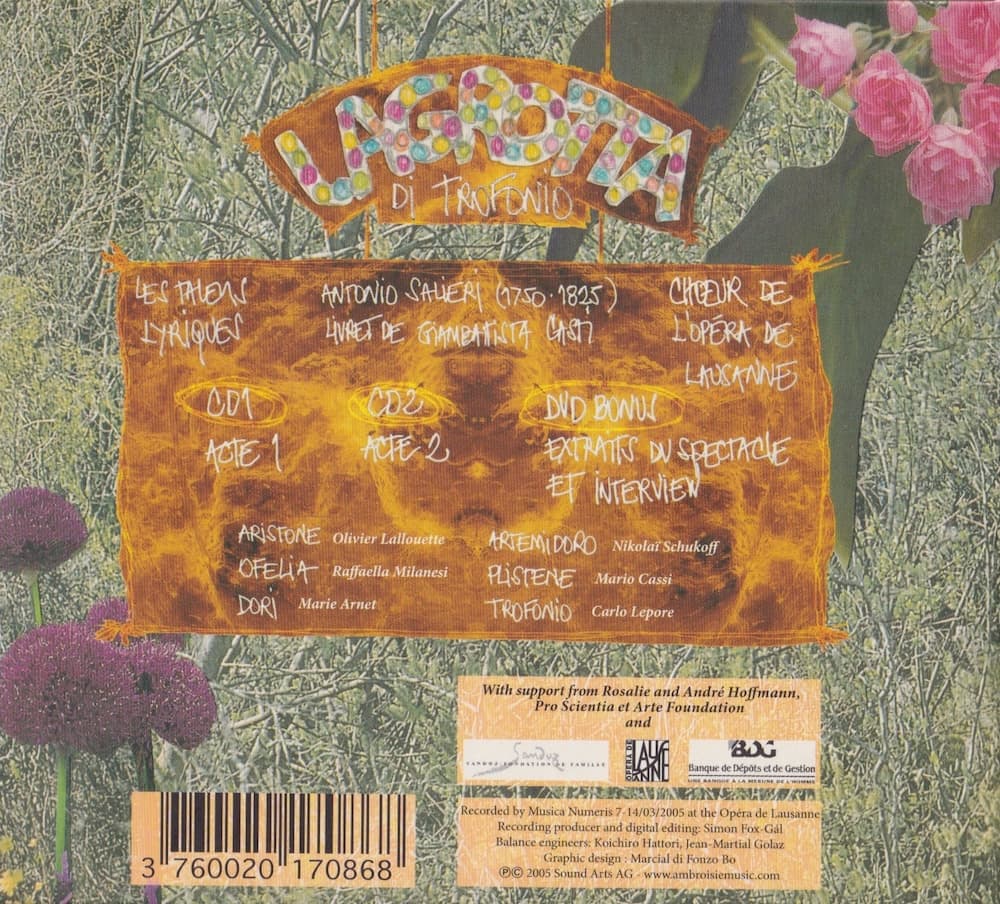
SALIERI, La Grotta di Trofonio
Year
2005
Production
Ambroisie Music
Direction
Christophe ROUSSET, Les Talens Lyriques
Mastering
Simon FOX GÁL / Koichiro HATTORI, Jean Martial GOLAZ
Photos
Marc VANA
Graphic Design
Marcial Di Fonzo Bo
Listen on your favorite streaming platform
Details
Metamorphoses of an opera
It has often been suggested that the first production of this work was one of the points of contention between Mozart and Salieri. However, chronology refutes that legend."
Da Ponte tells us that Salieri 'swore that he would rather lose a hand than set another line' of his poctry.
The composer must have been smarting at the failure of Il Ricco d'un giorno (1784). He preferred to turn to Giambattista Casti (1724-1803) whose Il Re Teodoro in Venezia for Paisiello had been a resounding success that same year.
Although we lack information about the different strata of the text, it is clear that the libretto printed in Vienna for the first performance is not the same as the one that was finally published with the score. In his Memoriale dato per Celia, Casti States that he wrote La Grotta di Trofonio to mock the Devil, and the magical exorcisms practised by sorcerers and charlatans, and the feigned paroxysms of wild-eyed fanatics and impostors. He peppered his text with erudite footnotes. Completely out of keeping with habitual practice, this brought him some derision.
The negative opinion of Da Ponte's friend Casanova was by no means shared by theorists of the time who, on the contrary, approved of Casti's attempts to renew the opera buffa genre. The literary historian and music critic Giovanni Andres wrote that he had 'introduced good taste and a new type of style into opera buffa, and had "brought esteem to a kind of poetry that hitherto had not been deemed worthy of the slightest consideration'.
At the first performance in Vienna the cast was as follows:
Ofelia: Ann Selina (known as Nancy) Storace Dori: Celeste Coltellini
Aristone: Francesco Bussani
Plistene: Stefano Mandini
Artemidoro: Vincenzo Calvesi
Trofonio: Francesco Benucci
The same singers also took part in operas by Mozart. They were chosen by Casti himself, according to Da Ponte, who also mentioned that his rival for the position of poeta cesareo was 'il protettore ed il vagheggino (the patron and wooer) of the two leading ladies.
Celeste Coltellini (1760-1829) was the daughter of the librettist Marco Coltellini, who had written the text for Salieri's Armida. In 1780 Joseph II wrote: 'Her voice is not as strong or as pleasant as Storase’s, her acting is overdone, but one cannot deny that she brings out different characters quite well and enters into them with case. Paisiello wrote for her Nina, o sia La pazza per amore (1789).
Fora in the the emperor had wished to have Coltellini compate vita Storace, which happened for the alonime in a Crotta di Trofonio. They found themselves face to face in their own roles as divas in Prima la Musica, poi le parole, written a few months later by Casti for Salieri.
Ann Selina Storace (1765-1817) later took the part of Susanna in Moza's Le Nozze di Figaro. From 1780 she specialised in comic roles (opera buffa). Charles Burney wrote: " In her own particular line of the
Stage she was unrivalled, being an excellent adress, as well as a materly singer' She gradually gave up bravura semi serie parts to specialise in the shorter, more lyrical arias, cavatinas and rondos that
Viennese audiences wished to hear her sing. La Grotta di Trofonio appears to have played an important part in that change of direction.
Francesco Benucci (1745-1824) was regarded as one of the greatest buffo caricato of his time. He was a fine actor with round and beautifully full voice, more bass than baritone. Joseph II saw him as one of the finest elements in the company, and even more valuable than Storace (letter of 29 September 1786). The list of parts he took in Vienna is impressive, including Figaro at the première of Le Nozze di Figaro, Leporello in the first Vienna performance of Don Giovanni, and Guglielmo in the première of Cosi fan tutte.
Francesco Bussani (1743-1807) later created the role of Don Alfonso in Così fan tutte and sang the
Commendatore and Masetto in the first Vienna performance of Don Giovanni. He had an amazingly long carcer as a singer and was cast both in baritone and tenor roles, He often played older characters,
fathers and elderly men.
Vincenzo Calvesi (? - 1811), who later created the role of Ferrando in Mozart's Così fan tutte, was described as 'one of the best Italian tenors (...] with a voice that is naturally sweet, pleasant and sonor-
ous (Grundsätze zur Theaterkritik, 1790). He was also noted for his clear diction.
Stefano Mandini (1750-1810?), who was to be Almaviva in Le Nozze di Figaro, had previously taken the same part in Paisiello's Il Barbiere di Siviglia. He was described as primo buffo mezzo carattere.
Regarded as an excellent actor, he took both tenor and high baritone roles.
Several important dates can be dedlaced from the diary of Count Karl Zinzendort, a regular opera and cheatre goer who had been given frendom of the bouse by Count Orsini-Rosenberg, the man in charge of opera in Vienna. the libretto was already well advanend by zy Rebruary 198s, Rehearsals began around May and were held up by Storace & ill health. Sach was the singer's popularity that her recovery was celebrated in September by a cantata. Per la recuperata salute di Ofelia (now lost), compened jointly Ar Salieri, Morart and Cornetti to a text by Da Ponte
Dazendort attended the première at the Burgtheater on 1a October liss: "The charming music, the extraondinary codumes, Storace with her philosopher'à mantle was pretty, and Calvesi perfectly good.
Cobellini was marvellous in her roke. Benucci as the old Philwopher. But the subiot was lacking in genius, in artidry; there were no decors. forever the garden, forever the grotto, forever the transmuta-Goes. la Scenes ['l dilerto che in petto mi sento.."] Mandini and Coltellini were the most outstanding te Scene o they brought out the calamit and olived (at the end of the scene) very well. Bussani gave an indiferent performance of his part. At the beginning of the first finale Storace sang well. I un piacet col care amante" Act Il. Stone o, with the two women, is charming. At the end of Scene to Casti her adulod a Terzetto that is very attractive, "Qua, qua, qua" (Al Il, Scenes "Ma perche in ondine") Senucci performed the Sorcerer's invocation wonderfully. Scene 18.
On 34 (tober he added: "The two arias by Storace, "D'an dolce amor la face" and "T' un placer col caro amante" are admirable, as are the duet for Coltellini and Mandini, Certamente il mattrimonio" the Toretto for the men in Act 11. Scene to, the duet for Calvesi and Storace in Scene 14, "Que muse kojona", the Terzetto for the two women and the magician in Scene g, the finale... everything is admirable"
la bis Pramategiche Monato, the drama critic Johann Friedrich Schink saw La Grorta di Defenio as the eutone of Viennese opera.
La Chetra di Deforio was an immense success: it was performed twenty six times in all between ibe promuère in pos (seven performances that year) and piz. by way of comparison Le Nonae di Fire was performed only nine times over a similar period, befove the taão revival. Adaptations of la Crueta circulated.
The complete score of the opera was the only one published during saleri hetimes & was also th inst egema befa to be poblished in its entirety (Artaria, 1786).
The opera travelled all over Europe. In the ten years following the première, there were about thirty different productions, including those of Leipzig, Dresden, Warsaw, Prague, Trieste, Paris, Parma, Lisbon, Riga, Copenhagen and Görz.
To productions - in Paris and London - are particularly worth mentioning because of their connection with singers who appeared in the first performance.
LAntre de Trofonius, a parody in French to Salieri's music, was prepared for the Comédie-Italienne in Paris, but was refused (Journal Général de France, 18 March 1790). The work was therefore given in Italian at the Theâtre de Monsieur on 15 March 1790 with Stefano Mandini as Plistene. The music was highly praised: "The orchestral part is rich and skilful, with some superb effects' (Chronique de Paris,
15 March 1790); 'The music is worthy of this great Master, a pupil and follower of Gluck. Several arias and the finale of Act II especially are masterpieces' (Journal général de la Cour et de la Ville, 18 March
1790). Cherubini was probably the composer of the two additional arias in that production.
In London, Stephen Storace included excerpts from his sister's successes on the continent in his own compositions, The Siege of Belgrade, first performed at Drury Lane on 1 January 1791, is partly by Storace, the other part being an adaptation of Una cosa rara, which Martín y Soler had composed for her in Vienna. Stephen Storace also added the Rondo alla turca from Mozart's Sonata K331 and the minuet 'Che filosofo buffon' from La Grotta di Trofonio. 'Storace danced her favourite air with much grace - it was encored' (The Gazetteer, 4 January 1791). As she probably performed this piece as at the first performance in Vienna, we may imagine that Ofelia originally danced around Trofonio in this part of the opera.
Salieri's opera was adapted even more radically when it was presented on 3 May 1791 under the title The Cave of Trophonius. Ann Storace took her Viennese role under the name of Daphne. All that remains of this pastiche, which used none of Salieri's music, is the manuscript copy that was presented to the censors, and a few passages that were published in 1791.
In 1817 Spontini asked Salieri to set the recitatives for a new French version. Unfortunately, we know nothing at all about what happened after that.
Rossini apparently knew La Grotta di Trofonio well and would sometimes hum parts of it, according to Geltrude Righetti Giorgi (1823).
Emmanuelle and Jérôme Pesqué
With Special thanks to Ms Dorothea Link
(1) The emperor had commissioned three operas, one by Regini (Il Demogorgone) another by Salieri (Il Grotta di Trofonio) and one by Mozart (Le Nozze di Figaro). 'These three pieces were nearly ready for representation at the same time, and each of the composers claimed the right of producing his opera for the first.' (Michael Kelly, Reminiscences, 1826, znd ed.) In fact Mozart began work on Le Nozze di Figaro as La Grotta was receiving its first performances at the Burgtheather. (Translator's note.)