Back to Discography
Guest
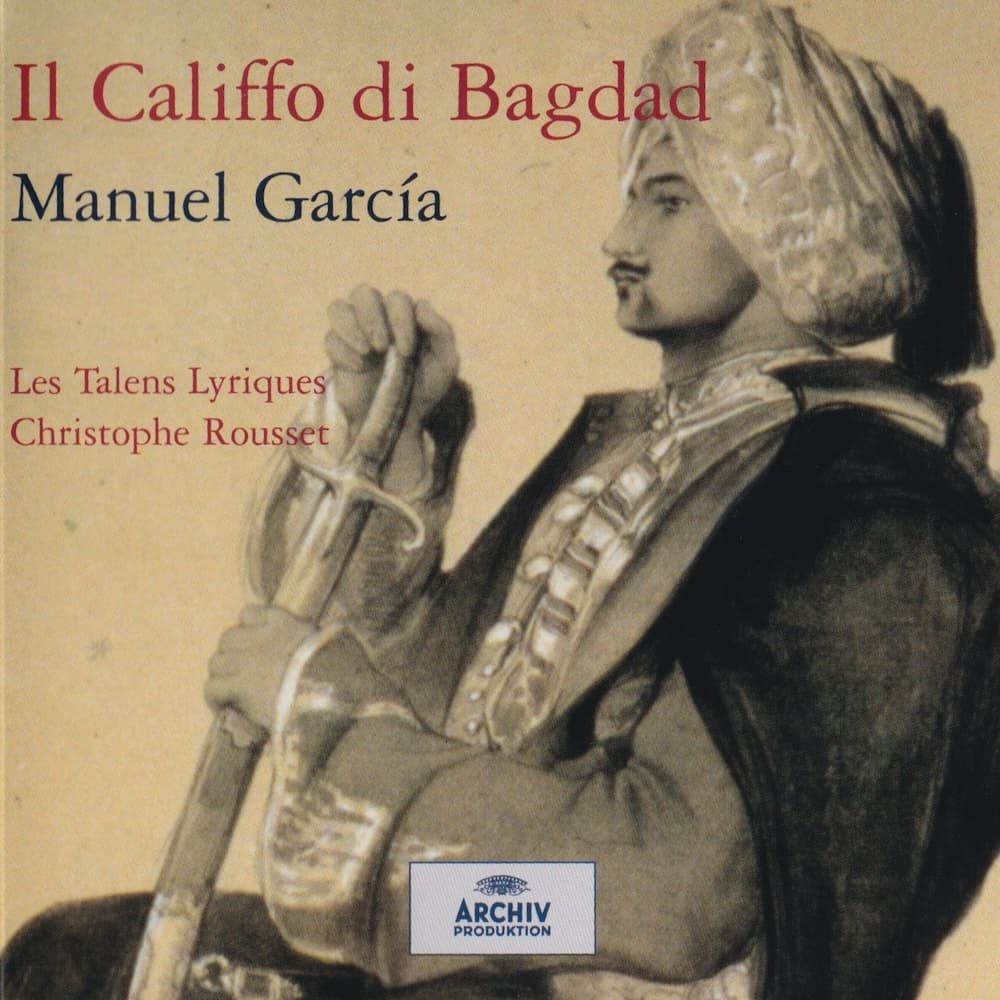
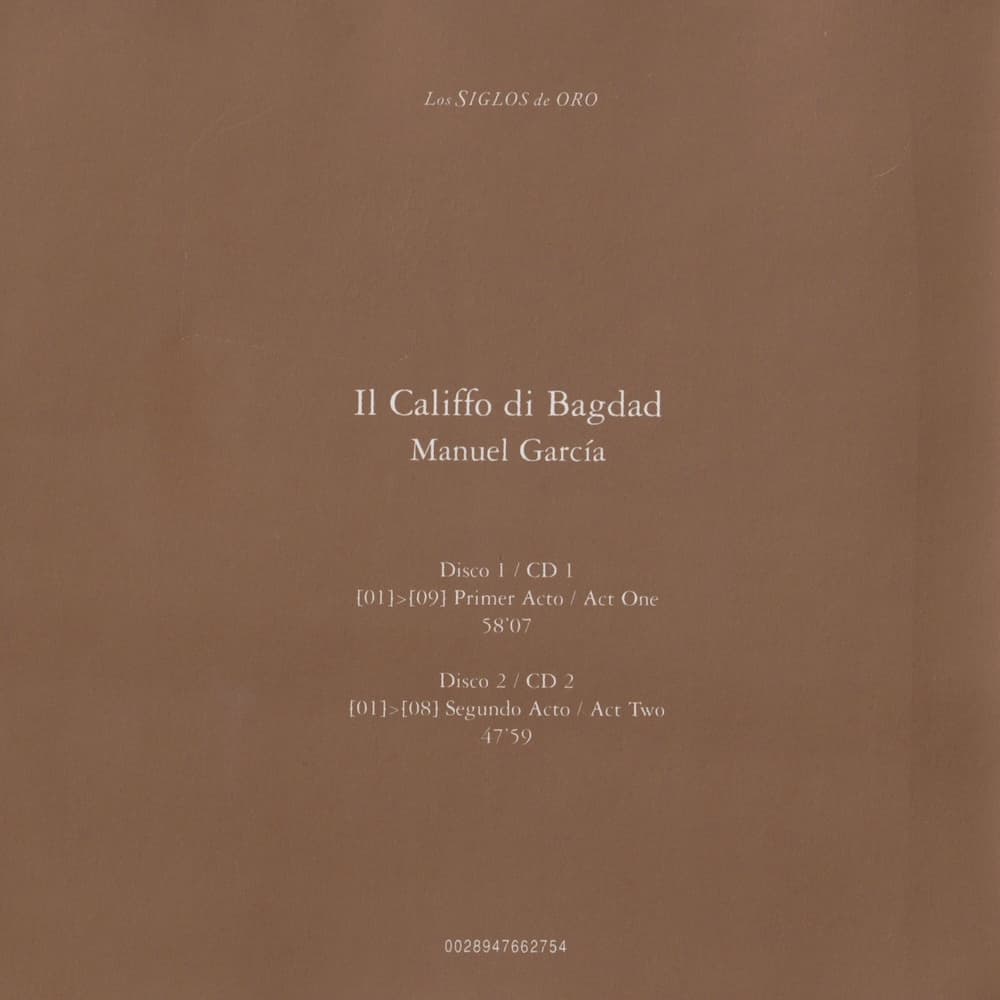
Il Califfo di Bagdad, Manuel GARCÌA
Year
2007
Production
Antoni PARERA FONS
Direction
Mastering
Albert MORALEDA
Photos
Graphic Design
VIctor PAGAN
Listen on your favorite streaming platform
Details
Il Califo di Bagdad: from "opéra-comique" to "opera buffa"
Composer and tenor Manuel del Pópulo Vicente Rodríguez García (Seville, 1775-Paris, 1832) is less well known today for his operas than for his famous offspring - the stars of the Romantic stage María Malibran and Pauline Viardot, and his namesake, the renowned baritone Manuel García. His composing career, however, began as early as his singing career - in Madrid, at the Teatro de los Caños de Peral, where he made his stage debut and produced his first two tonadillas (short pieces performed between the acts of a longer stage work): EL majo y la maja and La declaración (1798 and 1799).
Over the next three decades he wrote around fifty operas with librettos in Spanish, French and Italian. Not all of these were staged, but they were composed for some of the great operatic centres of the world, all places in which he lived and worked for a time: Madrid (1798-1807), Naples (1811-
1816), Paris (1808-1811; 1817-1825; 1830-1832), Mexico City and New York (1825-1829). Some of his Spanish works date from his time in Madrid, others from a brief visit to Mexico City, in 1827 and 1828. All his French operas were written between 1817 and 1825, when his somewhat stormy relationship with the director of the Théâtre Italian, Madame Catalani, forced him to try his luck with other Parisian theatres (the Opéra-Comique and the Opéra in particular).
During these difficult years, García undertook a number of journeys around Europe, including a visit to London in 1818 where he received particular acclaim for his appearances in Italian opera. His travels and the Parisian situation explain the fact that the majority of his works were settings of Italian texts. He wrote more than thirty such operas, for many different cities, including New York, which also owes to García its discovery of Rossini's operas. (The Spanish tenor, along with his compatriot soprano Isabel Colbran - who became Rossini's wife - was one of the singers who did most to gain international recognition for the composer in the early years of his career.)
García's singing and composing talents going hand in hand, he developed a network of professional relationships across both France and Italy. After his first three-year stay in Paris, during which he garnered acclaim as a singer at the Theatre Italien and must have come into contact with French opéra-comique, he moved to Naples. In the end he spent five years in Italy, during which time he met Rossini and created the role which would make him the most famous tenor in the world, that of Almaviva in Il Barbiere di Siviglia (Rome, 1816). And it was while he was in Naples that he wrote Il Califfo di Bagdad, basing it on a very popular opéra-comique. He had recently met his librettist, Andrea Leone Tottola (d. Naples,
1831), a prolific writer who produced more than fifty Italian librettos in a thirty-year career, several of them adaptations of French originals. French works were particularly popular in the musical centres of Europe in the early nineteenth century; in Vienna, for example, Beethoven based his Fidelio (1805) on a lyric drama entitled Léonore ou l'Amour conjugal (Paris, 1798), telling how a wife rescues her husband from jail in Revolutionary France.
It is therefore no surprise to find that García had continued his composing career in Naples, nor that he took his inspiration from a French text, namely Le Calife de Bagdad (1800).
Made popular in its setting by François-Adrien Boieldieu (1775-1834), Le Calife de Bagdad was the most frequently performed opéra-comique during the Empire. Exoticism was very much in vogue at the time, Napoleon's Egyptian campaign having made the East and tales of harems flavour of the day. At a time, however, when Paris was less than familiar with Mozart's works and when Aloysia Weber (his sister-in-law) could play Konstanze in Die Entfübrung aus dem Serail to an empty auditorium, it is in fact to French grand opera that one must look for the main source of inspiration for Le Calife. The aria "De tous les pays pour vous plaire", in which the servant-girl Késie sings a series of pastiches in different national styles, echoes a much-loved scene from La Caravane du Caire (1785), one of the most popular works of the French composer André-Ernest-Modeste Grétry. The use of the exotic was also a way of making political points to audiences during the years of the Consulate and the Empire:
Le Calife paints a less-than-flattering portrait of the Cadi, a Bagdad dignitary who abuses his power, using his position to steal from the people.
However, adapting the score of Le Calife for Neapolitan audiences required some significant alterations (even more than had Beethoven's reading of Léonore). For example, the casting of Isabella Colbran in the principal female role of Zetulbè gave García the chance to exploit her vocal talents to the full, and in doing so he utterly transformed the original into an Italian opera buffa. Likewise, while he had seen Le Calife with the great Parisian tenor Jean Elleviou in the principal role of Isauun, his desire to please audiences who loved and expected great vocal agility explains the fact that this role, tailored to his own talents, became one of his greatest triumphs in the opera houses of Italy. For with Isauun García laid the foundations for Almaviva, who owes his dramatic presence to a combination of Beaumarchais's writing and the vitality of Italian bel canto. Isauun and Almaviva's roles develop within similar plotlines: an eminent personage, a caliph or a count, is determined to win the heart of a beautiful commoner, all the while remaining incognito. The true love of the lady in question (Zetulbe/Rosina) is rewarded by an extremely advantageous marriage. García's revisions do not, therefore, lie in the plot itself, but in the different conventions of French and Italian opera.
In its original version, Le Calife de Bagdad was a one-act piece in which spoken dialogue predominated over sung numbers.
Like many opéras-comiques of the early nineteenth century designed to form just part of an evening's entertainment, alongside other short works, Le Calife was written for a troupe of singer-actors whose success depended as much on their dramatic abilities as on their vocal talents. In adapting the story for a Naples opera house and for a singer of the stature of García, Tottola had to bear in mind the Italian conventions that required the dramatic structure to be tightened up, the amount of orchestral accompaniment to be substantially increased and the main roles to be rethought for virtuoso singers. The librettist transformed Le Calife into a two-act opera buffa in which the musical elements outweigh the spoken dialogue. The French opera includes seven sung numbers as well as the overture, for a story involving six characters, of whom one (the Cadi) is a non-singing role. Moreover, only three of the characters have an aria (Kesia, Isauun and Zetulbe), unthinkable for an opera buffa in a post-Mozart, post-Paisiello world.
Tottola and García, by contrast, provided sixteen sung num-bers, and gave an aria to each of the six main characters.
Isauun's only aria in the French version was incorporated into an ensemble number, its effectiveness stemming from its delightful vocal line. In the Italian version it becomes a maior scena, made up of an accompanied recitative and an aria without peer on the French stage and a clear forerunner of Almaviva's "Cessa di più resistere" from the end of Il Barbiere di Siviglia. Also noteworthy is the fact that Boieldieu gave the only bravura piece to the servant-girl, Késie (*De rous les pays pour vous plaire", Scene S), while Zetulbè was given a romance, as befitted a French première amoureuse. For Naples, García moved this aria to the second act and gave it to his Zetulbè, now an Italian prima donna innamorata and, as such, an agile soprano. Composer and librettist also brought ensemble numbers to the fore: there are no fewer than four trios and two duets in Il Califfo, as opposed to one trio and one duet in Le Calife. Above all, they opted to set far more of the action to music, reducing the amount of spoken dialogue and replacing it with such typically buffa elements as an introduction (after the overture), and a finale for each act, the first of which is 622 bars long and provides a sustained and lively ten-minute segment of the drama.
While well-informed listeners may discern echoes of the French source here and there, Il Califfo di Bagdad presents itself first and foremost as a skilfully composed opera buffa, with an effective plot, and surprisingly modern in feel.
Greeted enthusiastically by Neapolitan audiences in 1813, it conquered the French stage in 1817, two years before the Parisian premiere of Il Barbiere di Siviglia. García's opera was favourably compared in its day to its French model, Parisian critics mentioning him in the same breath as Mozart and Cimarosa, without anticipating that this cosmopolitan Spaniard actually constituted the vanguard of a profound change in musical tastes. Indeed, so profound was this, that García the composer and his Califfo were to leave far less of an impression on musical history than was García the great Rossinian tenor.